
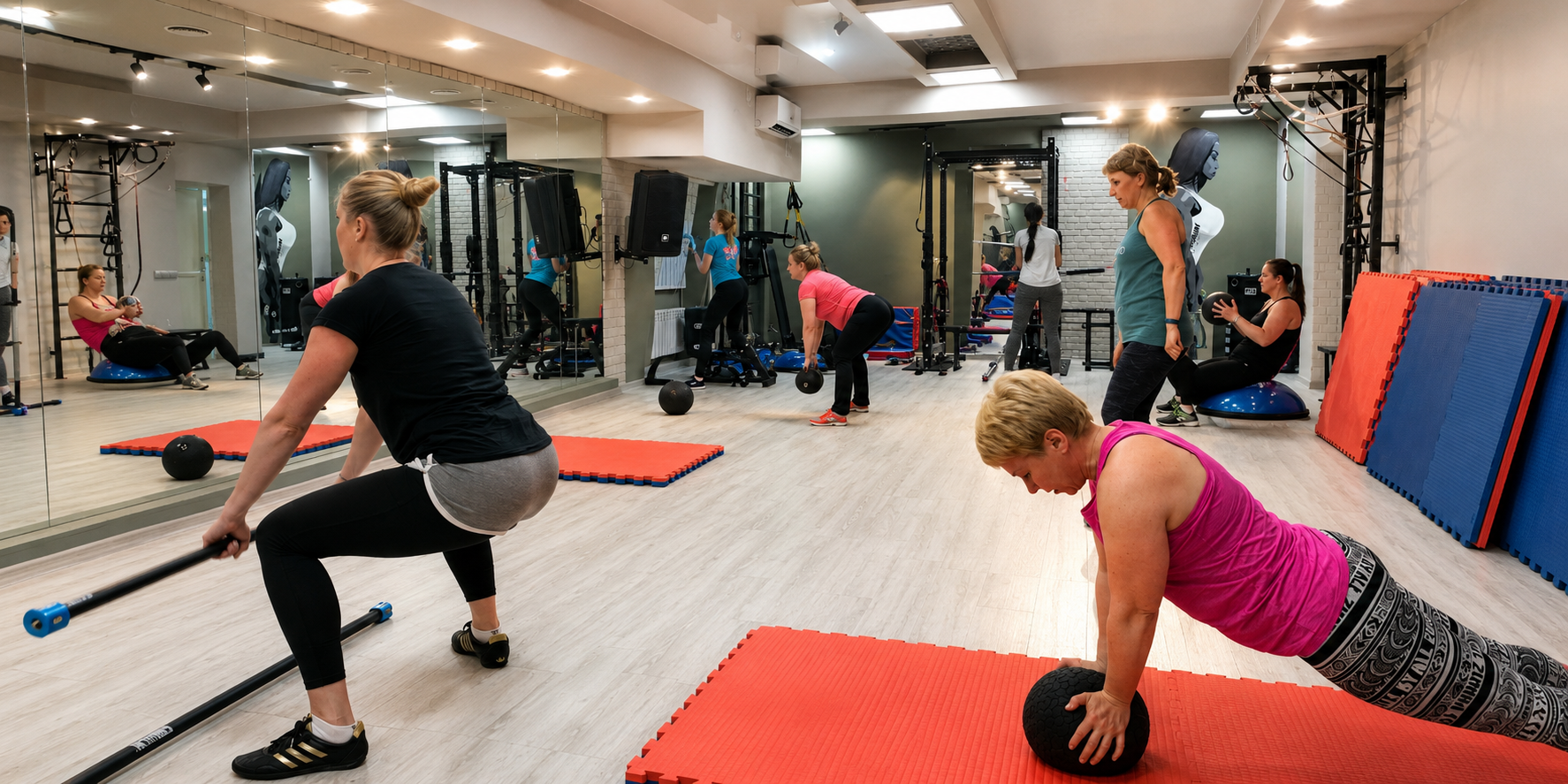
Why I Love Circuit Training
The group works together, but everyone stays at their own level
There are some formats that stay with a trainer for years.
Not because they are fashionable. Not because they look good on a timetable. But because, again and again, you see how well they work in real life.
For me, circuit training is exactly that kind of format.
I have been teaching group fitness for many years, and circuit training remains one of my favourite formats. It can bringtogether strength, cardio, core muscles, balance, coordination, functional movement and good group energy.
But that is not even the most important part.
What matters most is that a circuit class can feel lively, varied and flexible enough that a person does not feel, “I have to do everything exactly like everyone else.”
Imagine the class.
There are several stations in the room. Atone station, there are dumbbells. At another, resistance bands. Somewhere else, a mat. A step or small platform. A balance exercise. A movement for the legs, one for the back, one for the core.
At first, it can feel a little intimidating, especially if a woman has not done strength training for a longtime.
“Will I manage?”
“What if I look worse than everyone else?”
“What if the exercise is too difficult?”
But a good circuit class is not built around everyone working in exactly the same way.
One person works with body weight. Another picks up dumbbells. A third chooses a low-impact option. A fourth uses a smaller range of movement. A fifth may be ready for more resistance or an extra coordination challenge.
The group moves together.
But each person has their own level of load.
And in my view, this is one of the main reasons circuit training works so well for adults, and especially for womenafter 40.
It is not just about “getting sweaty”
After 40, many women no longer want to train only to “smash themselves” or leave the class completely exhausted.
They want something different.
They want to feel that the body is getting stronger. That it is easier to get up from a chair. That climbing stairs feels calmer. That the back holds itself with more confidence. That the legs feel more grounded. That the core supports movement, instead of feeling like something that is just “somewhere there”. That after training, there is not only tiredness, but also the feeling: “I did something good for myself.”
A well-designed circuit training class can offer exactly that.
It does not train one muscle as if it exists separately from the rest of life. It teaches the body to work as a system: to stand up, sit down, pull, push, shift weight, hold balance, turn, use the breath, react, stay steady and keep moving when fatigue begins to appear.
In ordinary life, we do not move according to a textbook.
We do not say to the body: now only legs, then only back, then only abs.
We stand up, carry bags, climb stairs, bend down, turn, keep our balance, walk on uneven ground, pick something up from thefloor, reach for a shelf, sit down and get up again.
And a good circuit class is very close to that reality.
It can be energetic without being chaotic. Varied without being random. Lively, but still well thought through.
Why the body starts to feel different
One client once told me that after training, her back had “straightened up”.
Professionally, I would describe it more carefully: she had developed a better sense of posture, stability, body position and the muscles that help the body hold itself together.
But I understand what she meant.
Sometimes a person really does begin to carry herself differently. Not because a miracle happens in one session, but because the body gradually receives the right signals.
When we work with the legs, glutes, back, shoulder girdle and core muscles, the body begins to organise movement better. The sense of support improves. A person becomes more confident shifting weight from one leg to the other, controls the trunk better, stands more steadily and finds everyday movements easier.
Another client said that her body had transformed.
Again, I understand what she meant.
Sometimes it is not only about appearance. Sometimes it is about strength. Sometimes about feeling more gathered. Sometimes about control. Sometimes about suddenly noticing: “I can do more than I thought.”
These changes are hard to reduce to numbers alone.
But they are exactly why many people keep training.
Not because every workout is easy. Not because the motivation is always there. But because, little by little, the body starts to respond.
Why it works so well in a group
Many people enjoy circuit training because of the variety.
You move from one exercise to the next. The whole body works. Time passes more quickly. There is rhythm, music, movement, a trainer and the energy of the group.
For people who enjoy group fitness but want a more serious muscle stimulus, it can be a very good format.
A pure cardio class can give mood and endurance. The gym can build strength, but for many people it feels boring, confusing or uncomfortable. Circuit training often sits in the middle: a lively group format plus real muscular work.
And there is one more important thing in a group.
You are not alone.
There are other people around you who are working too, getting tired too, choosing their own option too, learning too. Someone is stronger. Someone is more cautious. Someone has trained for years. Someone is just coming back after a break.
But in a good class, this is not a competition.
It is a shared space where everyone does their own work.
Sometimes that atmosphere is exactly what helps a person keep going. Training becomes not only a workout, but also part of the week, something you want to come back to.
A good circuit class needs to be thoughtfully designed
Circuit training can be a wonderful format, but a lot depends on how it is built.
Simply setting a timer and giving people ten exercises in a row is not enough.
A trainer needs to understand which muscle groups are working, why each exercise is there, how to alternate the load, where rest is needed, where technique matters, where cardio can be added and where impact should be reduced.
This is especially important for women 40+and older.
One group can include people with very different histories. Someone may have sensitive knees. Someone, a back issue. Someone, a shoulder. Someone may struggle with balance. Someone may have had an ankle injury. Someone may not have done strength training for years. Someone may have good endurance but not enough muscular strength. Someone may be afraid of load because previous workouts left the body too sore.
An experienced instructor does not see only the class as a program.
They see the people.
That is why circuit training in the hands of a good trainer becomes much more than a set of stations. It becomes a thoughtful system of movement.
There is a place for strength, but there are also options.
There is pace, but there is also technique.
There is group energy, but there is also an individual level.
There is load, but there is also respect for the body of the person who has come to train today.
Why I love this format
I love circuit training because it is practical.
It is not disconnected from life. In one class, we can train exactly what we need every day: leg strength, stability, back work, core control, breathing, coordination, balance, endurance and the ability to keep moving without panic or chaos.
I love it for its flexibility.
In the same group, one person can start gently while another gets a more serious challenge. One person can choose the no-jump option, while another adds more pace. One can work with light resistance, while another picks up a heavier dumbbell.
I love it for its energy.
When a group works together, a special feeling of movement appears. You hear the music, see people beside you, follow the rhythm, move from station to station, and the workout stops feeling like a boring list of exercises.
And I love it because it gives people a sense of progress.
It does not have to be loud or dramatic.
Sometimes progress looks very simple: climbing stairs more easily, standing more confidently on one leg, squatting more calmly, holding the back better, recovering faster after exercise, or feeling less afraid of a movement that once seemed difficult.
For me, this is very valuable.
Because after 40, fitness should not be punishment. It should help a woman live in her body with more strength, confidence and joy.
What to try tomorrow
If you would like to try circuit training, start calmly and attentively.
1. Choose a class that includes a strength component
For women 40+, classes that include bodyweight exercises, dumbbells, resistance bands or other forms of resistance can be especially useful. Not only cardio and sweat, but real muscular work.
2. Watch your technique, not only the pace
Faster is not always better. In strength and functional exercises, movement quality matters. A good class should not make you lose control just to keep up with speed.
3. Ask for options
A good instructor will offer an easier or more challenging version of an exercise. This is a normal part of training, nota sign of weakness.
4. Notice balance and stability
If after a few weeks you feel that you stand more confidently, climb stairs more easily or control your body better, that is a good sign.
5. Check how you feel the next day
After a good workout, the muscles may feel that they have worked. But if every class knocks you out for two days, the load needs to be adapted.
6. Look for a format you want to return to
Consistency becomes easier when training gives you not only load, but also mood, human contact and a sense of progress.
Sources
Systematic review and meta-analysis on circuit resistance training, strength, body composition and cardiorespiratory fitness in middle-aged and older women.
A broader systematic review and meta-analysis showing positive effects of resistance circuit-based training on strength, fitness and body composition.
Review showing improvements in body composition, muscle strength, cardiorespiratory endurance and functional autonomy in older adults.
Studies in middle-aged and older women showing improvements in functional ability, including lower-limb strength, gait and dynamic balance; related work also examined cardiorespiratory fitness.
Study showing improvements in muscle strength and balance in postmenopausal women.
6. Australian Government 24-hour movement guidelines for adults.
Guidelines recommending muscle-strengthening activities and functional activities for mobility, balance and coordination.
Want support beyond this article?
