
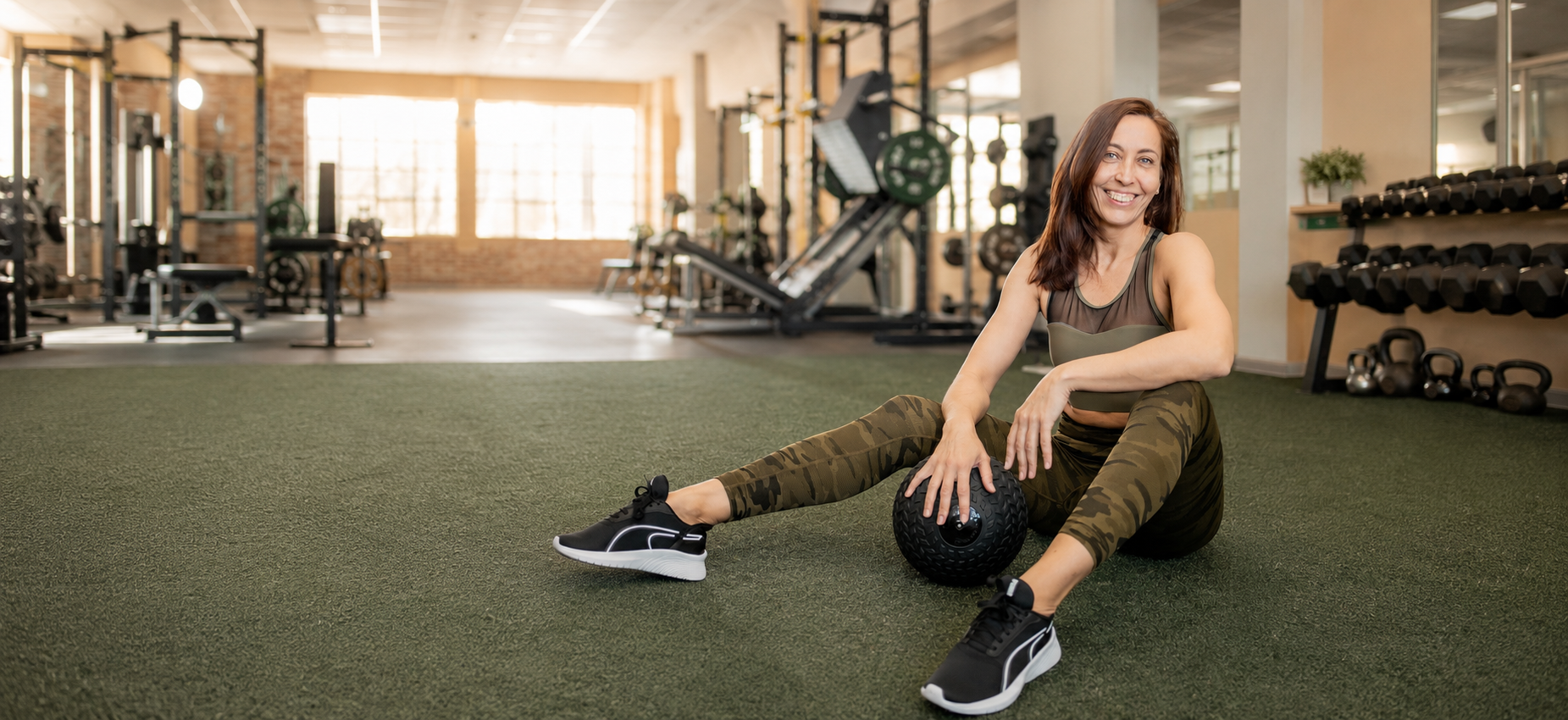
Why Strength After 40 Needs Different Support
Because being busy and moving all day is not the same as giving your body the training signal it needs
Sometimes a woman says to me, “Irina, I don’t understand why I need more training. I move all day already.”
And I understand exactly what she means.
She gets up early. Sometimes at five in the morning. She gets the children ready, helps the family, thinks about work, the house, shopping, schedules, documents, meetings, dinner, and ten other thing sat once. Then she goes to work, climbs stairs, moves from one meeting to another, answers messages, stops at the shops, cooks, organises, reminds, supports, and solves other people’s problems.
By evening, she is not just tired. She is drained.
And if someone says to her in that moment, "You need to move more”, it can sound almost unfair.
Because she really has not spent the whole day lying on the couch. She is not lazy. She is not irresponsible. She moves, does, holds life together, and often she does not feel as if there is even one free centimetre left in the day.
But there is an important difference here, and it is rarely explained in simple language.
Being exhausted from life and giving your muscles the right training signal are not the same thing.
You can be on your feet all day and still not train strength. You can rush between tasks and still not give the glutes, thighs, back, deep core muscles, and shoulder girdle the progressive stimulus that helps them become stronger. You can feel physically worn out and still not get the kind of load that supports muscle, bones, posture, metabolism, stability, and confidence in movement.
After 40, this becomes especially important.
Not because the body “breaks” or suddenly becomes weak. But because old habits often stop producing the same result. What used to somehow work on its own now needs more attention: sleep, food, recovery, stress, strength training, and consistency.
Your old routines may no longer work, and that does not mean you have failed.
It may mean that your body now needs a different kind of support: not harsher, not rougher, and not through punishment, but smarter, more precise, calmer, and more individual.
Strength after 40 should feel supportive, not punishing.
Muscles do more than simply move the body
We are used to thinking about muscles too narrowly. Muscles help us move. Muscles make the body look more toned. Muscles support bones and posture. All of this is true, but it is only part of the story.
Muscles are not silent.
When muscles work, they send signals. In science there is a specific word: myokines. These are small signalling molecules released by working muscles that help them “talk” with other tissues and organs: fat tissue, the liver, the pancreas, bones, the brain, and the immune system.
You do not need to remember the word “myokines”. But the idea itself is important.
Working muscles tell the body: “I am here. I am needed. I am participating.”
That is a very different message from the one the body receives from muscles that spend the whole day tolerating sitting, stress, rushing, and fatigue, but never receive real strength work.
Movement is not only about “burning calories”. And muscles are not only about body shape.
Muscles are part of the body’s internal conversation about energy, recovery, inflammatory processes, metabolism, stability, movement, and brain function. This does not mean strength training “treats” every problem or guarantees a specific result. That would be wrong to say. But working muscles are involved in a much wider health system than simply “legs, arms, and abs”.
That is why I see strength after 40 not as a way to punish the body for age or weight, but as a form of support.
Strong muscles help a woman not only look more toned. They help her get up from a chair, climb stairs, feel less afraid of an uneven path, hold her trunk with more confidence, and better sense her hips, pelvis, back, and feet.
The glute muscles, thigh muscles, deep core, diaphragm, and pelvic floor do not work separately from each other. They are part of a larger stability system. When the hips and glutes do not give the leg good support, the body starts looking for compensation in the lower back, knees, ankles, or posture. This does not mean that one weak area automatically creates a problem somewhere else. The body is more complex than that. But movement is connected, and this is why a good trainer looks not only at one exercise, but at how a woman moves as a whole.
How she squats. How she stands up. How she walks. How she holds her pelvis. How she stabilises her trunk. How she shifts weight. How she breathes. How she gets tired. How she recovers.
After 40, strength is no longer only about “getting toned for summer”. It is about the woman you want to be in ten, twenty, or thirty years.
Strength is not vanity after 40. It is preparation.
Preparation for staying active, stable, independent, alive, and confident in your body.
Why a reason able plan can still fail
Not every activity, and not every workout, gives the body the result it needs.
Many women after 40 know a lot. They read, research, save exercises, buy programs, try classes, watch videos, ask apps, and sometimes even build a plan with the help of AI. They understand that protein matters, sleep matters, stress affects the body, and strength training is needed.
But when we look at the real week, it often becomes clear that the problem is not one big mistake. The problem is small breaks in the system.
Training exists, but there is no progression. The exercises look “right”, but they do not match the woman’s level of strength, mobility, posture, or pain limitations. The load is either too soft for the body to adapt, or too sudden to be sustained for more than two weeks. The food looks healthy, but it does not support muscle and recovery. Protein is low, or spread through the day in a chaotic way. Sleep is always left “for later”. Stress is treated as part of life, not as a factor that affects the training plan. A woman is doing a lot, but the actions are not connected into a system.
Sometimes a plan looks reasonable from the outside, but inside it does not support the body well enough.
This is where a professional eye matters.
Not because a woman is unable to care for herself. Quite the opposite. Often she is very smart, responsible, and disciplined. But a professional sees what is hard to see from inside your own life.
A professional does not only give exercises. A professional sees the missing connections.
As a trainer and health coach, I do not look only at which exercises a woman does. I look at how those exercises connect with her body, energy, food, sleep, stress, pain, schedule, confidence, and real life.
If a woman sleeps badly, eats whatever happens, sits in tension all day, collapses in the evening with no energy, and then tries to do a random hard workout, the body may not respond the way she expects. Not because the body is “bad”, but because the system is not supporting the result.
Your training plan and your food patterns should not fight each other. They should support the same body.
That is why after 40, what is often needed is not another harsh fitness plan.
You may need a system that connects strength training, nutrition, sleep, recovery, stress, movement during the day, and your actual schedule. Not an ideal schedule from a book. Not someone else’s schedule from Instagram. Your life: the one that includes work, family, fatigue, responsibilities, changes, sometimes poor sleep, sometimes strong stress, sometimes good weeks, and sometimes weeks where the goal is simply to hold steady.
This is about building a system that fits your body and your real life.
When the system truly fits, consistency becomes easier. Not because you suddenly become a different person, but because the plan stops arguing with your life.
A calmer way to begin
For one woman, the right starting point maybe a private strength session where we calmly assess movement, technique, strength, balance, and confidence. For another, it may be a softer program where the first step is restoring consistency, recovery, and basic energy. For a third, it may be work on nutrition, protein, daily rhythm, and evening fatigue, so that training stops feeling like one more stress. For a fourth, it may be a gradual return to load after a long break, pain, menopause-related changes, or lost confidence.
You do not need to be fitter before you start.
This is very important.
Many women think, “First I will lose a little weight, get stronger, get back in shape, and then I will go to a trainer.” But private support is not only for when you have already done everything by yourself. It is exactly what can help you start from where you are now.
Private coaching gives you space to be supported, not judged.
In private work, you can calmly say: “I am tired.” “I am afraid of looking silly.” “I don’t know where to start.” “I don’t want a harsh gym environment.” “I have tried before and quit.” “I need someone to look at the whole picture.”
And that is not weakness. It is an adult, sensible way of caring for yourself.
The Midlife Strength & Vitality Program was created for exactly this kind of approach. It is not simply a set of workouts. It is a personalised support system where we look at strength, nutrition, recovery, life rhythm, energy, confidence, and how to make the plan real, not just beautiful on paper.
The goal is to feel stronger, more energised, and more confident in your body again.
Not to become perfect. Not to punish yourself for age. Not to start a new life on Monday.
But to gradually build a body you can trust more.
A body that gets up more easily in the morning. A body that moves with more confidence. A body that tolerates load better. A body with enough strength not only for training, but for life.
A calmer way to begin is the First Step Session.
This is a private starting session where we look at your goals, movement, current strength, energy level, lifestyle, schedule, and what kind of support you genuinely need now. Sometimes after this session, it becomes clear that the Midlife Strength & Vitality Program is the right fit. Sometimes you may need a gentler entry point first. Either way, it is not a test you need to “pass”. It is a starting point.
If you are a woman 40+ in Sydney and you want private support to feel stronger, more energised, and more confident in your body again, you can begin with a First Step Session.
Message Irina with the word VITALITY to ask for details.
Sources
1. Australian 24-hour movement guidelines for adults- support the importance of regular physical activity and muscle-strengthening activities at least 2 days per week.
2. NICE Menopause Guideline NG23 - emphasises the importance of maintaining muscle mass and strength through physical activity during menopause.
3. Muscle-Organ Crosstalk: The Emerging Roles of Myokines- supports the idea that skeletal muscle acts as a secretory/endocrine organ,releases myokines, and participates in communication with other organs.
4. Optimal resistance training parameters for improving bone mineral density in postmenopausal women - supports the careful statement that resistance training may support BMD in postmenopausal women, especially at the spine and hip.
Want support beyond this article?
