
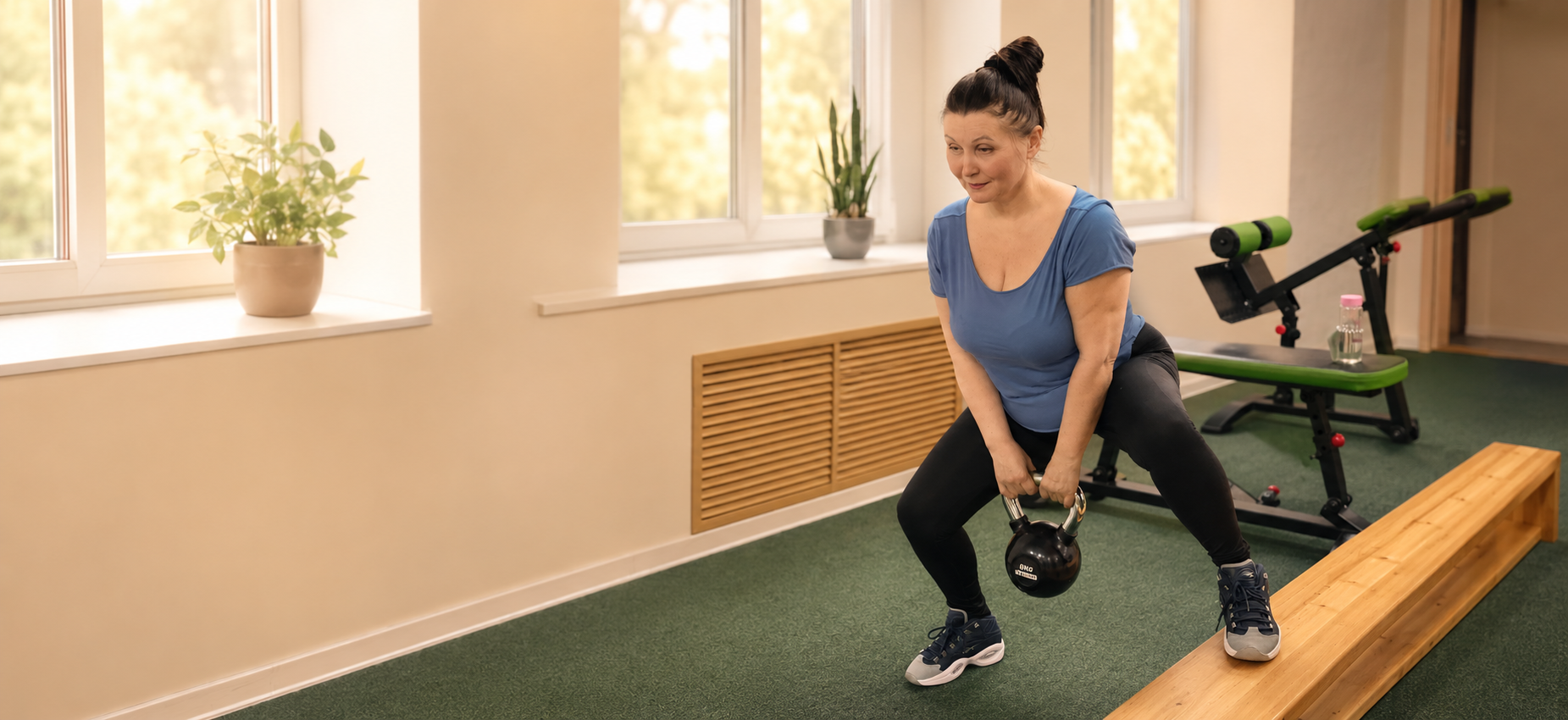
Bones Don’t Like Fear: Why They Need Load After 40
When I turned 50, I returned to competitive sport. Not just to “move a little more”. Not just to “stay in shape”. I returned to serious strength training, heavy lifting, and the feeling that the body can be strong not only in youth.
For some people, that sounds brave. For others, too brave. A woman over 50 in competitive sport - is that even possible? It is.
And now I understand: it was never only about competition, discipline, or my love of strength. It was about trusting my body. About making an inner decision not to accept the idea that after a certain age life should become smaller, quieter, and more cautious.
Of course, I don’t believe every woman over 40 should start powerlifting. My path is my own. But I do know this: after 40, after 50, and beyond, the body needs load. Muscles need work. Bones need a signal. The body needs to understand: “I still move. I still carry. I still take part in life.”
When a scan makes everything feel more fragile
Recently, I had a DEXA scan. The result showed osteopenia. Not osteoporosis, but already reduced bone density. There is osteoporosis in my family history, so I can’t say the result was a complete surprise. Still, when you see those words written on paper, everything goes quiet for a moment.
Bones are a strange subject. We rarely think about them until they force us to. Muscles get tired. Your back reminds you after too much sitting. A knee reacts on the stairs. But bones are usually silent.
Osteopenia and osteoporosis rarely feel like “bone pain”. That’s why osteoporosis is often called a silent condition: many people don’t know they have it until a fracture happens.
And this is where fear easily appears. When you hear “low bone density”, the instinct is often to become more careful. Don’t lift. Don’t jump. Don’t squat. Don’t take risks. Protect yourself like delicate china.
Bones need safe challenge, not fear
But bones do not become stronger through fear.
Bones are living tissue. They constantly rebuild themselves. Especially during menopause, when declining oestrogen levels can accelerate bone loss, bones need not complete rest, but the right kind of safe challenge. Not harsh. Not random. Not “the same for everyone”. It needs to be tailored to the individual.
For one woman, a serious load might mean 2 kg dumbbells because she has never trained before, is afraid of pain, feels unsure about balance, and is only beginning to reconnect with movement. For another woman, 2 kg is simply a warm-up because she has trained for 10 years, understands her body, and comes in needing a program adjustment, a new training plan, or help moving beyond a plateau.
“Heavy” is not an absolute number. It is the relationship between the load and your current level of strength, experience, recovery, confidence, movement quality, sleep, health history, and how your body feels today.
That is why I don’t like universal advice such as: “After 50, do these five exercises.” For one woman they may help. For another they may be too easy. For a third they may be too difficult. And for someone else they may not be appropriate at all - not until we strengthen the feet, improve balance, and help the body relearn how to squat, stand, pull, and stabilise safely.
Bones do not need heroics. Bones respond to consistency, gradual progression, and load that grows together with the body’s abilities.
What safe load can look like in real life
Walking is valuable. It supports cardiovascular health, mood, endurance, daily activity, and the habit of movement. But if we are talking specifically about bones, walking alone is usually not enough. Bones need strength training, resistance work, bodyweight exercises, balance, coordination, and sometimes safe impact loading - if appropriate for the individual.
In real life, this may look far less intimidating than people imagine: standing up from a chair without using your hands, climbing stairs, doing a rowing movement with a resistance band, practising balance while holding support, training with dumbbells, strengthening the glutes, back, and legs, and learning to feel more stable and confident in movement.
This is not about “breaking yourself with exercise”. It is about being able to live with greater confidence.
Because the real danger of osteoporosis is not the number on the scan itself. The real danger is fracture - especially after a fall that, years earlier, may only have caused a bruise.
And as a trainer, I think not only about bones. I think about muscles. Balance. Walking mechanics. How a person gets up from the floor. How they carry shopping bags. How they walk on uneven ground. How they react if they trip. How quickly they can regain balance.
Fracture prevention is not only about calcium and vitamin D. Yes, nutrition matters. Protein matters, just like calcium and vitamin D, especially in the presence of deficiency. But supplements alone cannot replace muscle, strength, balance, stability, and the ability to move well.
After receiving my DEXA result, I didn’t panic. But I also didn’t tell myself: “Well, that’s just age.” Instead, I looked again at what I can control: strength training, nutrition, protein intake, calcium, vitamin D, magnesium, recovery, sitting less, consistency, medical screening, and speaking with a doctor if risk factors are present.
Osteopenia is not a sentence. It is a warning. Almost as if the body is saying: “Please don’t forget about me. I need strength not someday later, but now.”
And I truly hope women over 40 can see this not as frightening news, but as an invitation. Not to fear the body. Not to avoid load. Not to wait until bones announce themselves through a fracture. But to begin building strength calmly, safely, and at their own level.
Maybe today that means 2 kg. Maybe it means an exercise against the wall. Maybe it means the first training session after many years away. Maybe it is the first step toward stairs, balance, confidence, and a body you can trust again.
Bones don’t like fear. They need life, movement, and strength. And they need a woman who does not surrender her body to age without a conversation.
What You Can Do Right Now
1. Learn your risk factors.
A family history of osteoporosis, early menopause, fractures after minor injury, low body weight, long-term use of certain medications, vitamin D deficiency, or low physical activity are all reasons to discuss with your GP whether a DEXA scan may be appropriate.
2. Don’t rely only on symptoms.
Osteopenia and osteoporosis are often silent before a fracture occurs. If you have risk factors, testing matters more than guesswork.
3. Include strength training at least twice a week.
The appropriate level is individual. For some women the starting point is 2 kg. For others it may look completely different.
4. Train balance.
Better balance reduces the risk of falls, and falls are one of the main causes of fractures.
5. Don’t rely only on walking.
Walking is beneficial, but bones usually also need resistance, muscle work, balance, and gradual progression.
6. Pay attention to protein, calcium, and vitamin D.
It is best to start with nutrition and blood tests, and discuss supplements with a doctor or qualified practitioner, especially if deficiencies or elevated risk are present.
7. Sit less.
Even short movement breaks during the day help the body receive the signal:
“I move. I am needed. I am active.”
Fact Check + Sources
1. Healthdirect Australia — Osteoporosis
Confirms that osteoporosis often has no symptoms before fracture, and that women lose bone density more rapidly after menopause.
2. RACGP + Healthy Bones Australia guideline / MJA 2025
Confirms current Australian recommendations regarding DEXA screening, risk assessment, calcium, vitamin D, protein intake, strength training, balance training, weight-bearing and impact exercise, and limiting prolonged sitting.
3. Ma et al., Menopause / PubMed — walking and BMD in peri- and postmenopausal women
Confirms that walking has been studied as a strategy for maintaining bone mineral density in peri- and postmenopausal women, though in practice it is most effective when combined with strength training, balance work, and progressive loading.
Supports the conclusion that exercise may improve bone mineral density in postmenopausal women, though outcomes depend on the type of loading, area measured, and program structure.
Want support beyond this article?
